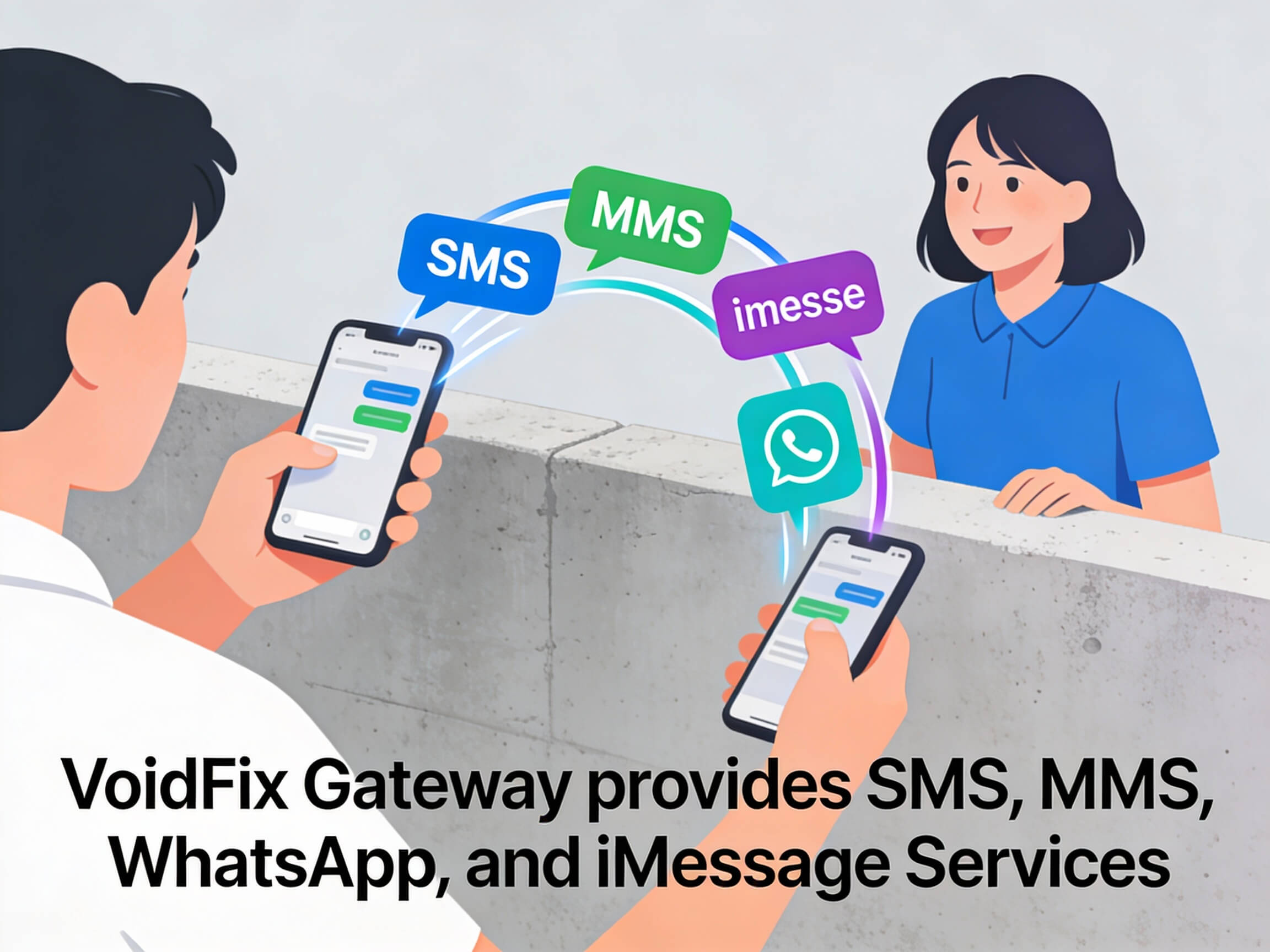
How SIM-Based SMS Gateways Work & Why VoidFix Gateway Delivers More Reliable Messaging
In a world where instant communication drives customer experience, SMS remains one of the most trusted and effective messaging channels.
Businesses rely on SMS for:
- Lead follow-ups
- Appointment reminders
- OTP verification
- Delivery notifications
- Customer engagement and support
But as messaging volume scales, many companies run into serious limitations with traditional SMS providers—high costs, A2P compliance delays, carrier filtering, and inconsistent delivery.
This is where SIM-based SMS gateways are transforming business communication.
And among the leading solutions in this space is VoidFix Gateway, built to deliver faster, more reliable messaging at scale.

SIM SMS Gateway: The Complete Technical Guide to SIM-Based Messaging for Business
The way businesses send SMS is undergoing a fundamental transformation. For years, companies relied on cloud-based SMS providers that route messages through carrier-controlled A2P (Application-to-Person) pipelines. While this approach served its purpose, the increasing costs, delivery inconsistencies, and registration complexity have driven a growing number of businesses toward a more direct solution: the SIM SMS gateway.
A SIM SMS gateway uses physical SIM cards inserted into Android devices to send text messages directly through mobile carrier networks. This approach bypasses the traditional aggregator chain entirely, giving businesses complete control over their messaging infrastructure while delivering higher reliability and dramatically lower costs.
In this technical deep dive, we will examine exactly how SIM-based messaging works under the hood, compare it against traditional cloud SMS providers, explore the architectural decisions that make this approach superior for high-volume sending, and explain how VoidFix Gateway has engineered the most robust Android SMS gateway available today.
How Traditional Cloud SMS Providers Route Messages
Before understanding why a SIM SMS gateway is superior, it helps to understand the technical architecture of traditional SMS delivery. When a business sends a message through a cloud provider like Twilio, Vonage, or Sinch, the message follows a multi-hop path:
- API call: Your application sends an HTTP request to the provider’s REST API with the recipient number, message body, and sender ID.
- Provider routing: The cloud provider receives the request and determines the optimal route based on destination country, carrier, and message type.
- Aggregator handoff: The provider passes the message to one or more SMS aggregators who maintain direct connections with mobile carriers.
- Carrier delivery: The aggregator submits the message to the destination carrier’s SMSC (Short Message Service Center).
- Last-mile delivery: The carrier’s SMSC delivers the message to the recipient’s handset.
Each hop in this chain introduces potential points of failure, delay, and cost. The aggregator may re-route messages through different paths depending on real-time conditions. Carriers apply their own filtering algorithms at the SMSC level. And every intermediary adds their margin to the final per-message price.
This architecture also means businesses have zero visibility into or control over what happens to their messages after the initial API call. If a carrier silently drops a message, the business may never know.
The Technical Architecture of a SIM SMS Gateway
A SIM SMS gateway fundamentally simplifies the message delivery path by eliminating intermediaries. Here is how the architecture works at a technical level:
The Hardware Layer: Android Devices as Messaging Endpoints
At its core, a SIM-based messaging system uses one or more Android smartphones as dedicated messaging hardware. Each device contains a physical SIM card from a mobile carrier, giving it a real phone number and a direct connection to the carrier’s mobile network. The Android operating system provides native SMS sending capabilities through its telephony stack, which the gateway software leverages to transmit messages.
Unlike GSM modems or specialized hardware that can be expensive and difficult to maintain, Android devices are affordable, widely available, and easy to replace. They also support dual-SIM configurations, effectively doubling the messaging capacity of each physical device.
The Software Layer: Cloud-Based Orchestration
Gateway software running on the Android device connects to a cloud-based management platform. This connection enables:
- Remote message queuing: Messages are queued in the cloud and dispatched to devices based on availability and load balancing rules.
- Multi-device coordination: When multiple devices are connected, the cloud platform distributes messages across them to maintain optimal sending rates on each SIM.
- Delivery status tracking: The Android device reports delivery confirmations back to the cloud platform, which makes status data available through dashboards and API callbacks.
- Inbound message handling: When recipients reply, the device captures the incoming SMS and forwards it to the cloud platform for processing by your CRM or application.
The Integration Layer: APIs and Webhooks
The cloud management platform exposes REST APIs and webhook endpoints that allow any external system to trigger messages. This means your CRM, marketing automation platform, e-commerce system, or custom application can send SMS by making a simple HTTP request, exactly the same way they would with any cloud SMS provider. The key difference is that the message then travels through your own SIM card rather than through an aggregator pipeline.
SIM-Based Messaging vs. Cloud SMS Providers: A Technical Comparison
Understanding the practical differences between these two approaches helps businesses make an informed decision about their messaging infrastructure.
Message Routing and Delivery Path
Cloud providers route messages through 3-5 intermediary hops before reaching the recipient. Each hop introduces latency, potential filtering, and cost markup. A SIM SMS gateway sends messages through a single hop: from the SIM card directly to the carrier network. The message enters the carrier’s system as standard mobile-originated traffic, indistinguishable from any personal text message. This shorter path means faster delivery, fewer points of failure, and no intermediary filtering.
Carrier Classification and Filtering
This is perhaps the most significant technical advantage of SIM-based messaging. Carriers classify traffic into two categories: P2P (Person-to-Person) and A2P (Application-to-Person). A2P traffic is subject to aggressive content filtering, throughput limits, and registration requirements. Messages from a SIM SMS gateway are classified as P2P traffic because they originate from a standard mobile device. This means they bypass the A2P filtering infrastructure entirely, resulting in significantly higher delivery rates.
Throughput Characteristics
Individual SIM cards have practical throughput limits based on carrier policies and network conditions, typically ranging from 200 to 2,000 messages per day depending on the carrier and sending patterns. However, throughput scales linearly with the number of devices. Ten devices with active SIMs can handle 2,000 to 20,000 messages per day. Twenty devices double that capacity again. This linear scaling model is actually more predictable than A2P throughput, which depends on carrier-assigned trust scores that can change without notice.
Cost Structure
Cloud SMS providers charge per message segment, typically $0.007 to $0.05, plus carrier surcharges and platform fees. A SIM SMS gateway leverages your carrier plan’s included messaging allowance. Most unlimited messaging plans cost $25 to $50 per month per line, regardless of volume. For a business sending 30,000 messages per month through a single device, the effective per-message cost drops to fractions of a cent compared to dollars with traditional providers.
Data Privacy and Control
With cloud providers, your message content and recipient data pass through third-party servers. With a SIM-based gateway, message content travels from your application to your own device to the carrier network. No third-party aggregator ever sees your message content or recipient lists. For businesses handling sensitive data such as healthcare information, financial details, or authentication codes, this direct path provides a meaningful privacy advantage.
How VoidFix Gateway Engineers a Superior Android SMS Gateway
While the concept of using Android devices as SMS gateways is straightforward, building a production-ready system that handles high-volume business messaging reliably requires sophisticated engineering. VoidFix Gateway addresses the technical challenges that basic SIM gateway setups cannot.
Intelligent Message Queue Management
VoidFix implements a cloud-based message queue that handles burst traffic gracefully. When your CRM triggers a batch of 5,000 messages simultaneously, the queue accepts them instantly and dispatches them to available devices at optimized rates. This prevents SIM overload while maintaining maximum throughput. The queue also handles retry logic automatically, re-attempting delivery for any messages that fail on the first attempt.
Multi-Device Load Balancing
For businesses running multiple Android devices, VoidFix distributes messages across devices using algorithms that consider each device’s current send rate, recent activity, and carrier network conditions. This balancing ensures no single SIM card is overworked while others sit idle, maximizing aggregate throughput and maintaining healthy sending patterns across all devices.
Adaptive Sending Rate Control
VoidFix monitors delivery success rates in real time and adjusts sending speeds automatically. If a particular SIM card starts experiencing delivery delays or failures, the system reduces its sending rate and redistributes load to other devices. This adaptive control prevents the cascading failures that can occur when a SIM card is pushed beyond its optimal sending threshold.
Comprehensive Delivery Analytics
Every message sent through VoidFix Gateway is tracked from queue entry through delivery confirmation. The platform provides detailed analytics including delivery rates by device, by carrier, and by time period. Businesses can identify trends, diagnose issues, and optimize their messaging strategy based on real data rather than guesswork.
Seamless Two-Way Messaging
Because messages come from real phone numbers, recipients can reply naturally. VoidFix captures inbound messages on the Android device and forwards them to your application through webhooks in real time. This enables genuine conversational messaging for customer support, appointment confirmations, and lead qualification without any additional infrastructure.
Scaling a SIM SMS Gateway: Architecture Best Practices
Building a scalable SIM-based messaging infrastructure requires thoughtful planning. Here are the architectural best practices that VoidFix Gateway implements and recommends:
- Device diversity: Use SIM cards from multiple carriers to distribute traffic across different networks and reduce dependency on any single carrier.
- Sending pattern management: Maintain natural sending patterns by spacing messages appropriately and varying send times. VoidFix handles this automatically through its rate control algorithms.
- Number rotation: Distribute outbound messages across multiple phone numbers to maintain a healthy sending profile on each number.
- Device monitoring: Keep devices connected to reliable power and internet sources. VoidFix alerts you immediately if a device goes offline so you can address connectivity issues quickly.
- Capacity planning: Plan your device count based on your peak daily volume requirements, not your average. VoidFix’s dashboard makes it easy to monitor utilization and identify when additional devices should be added.
Common Use Cases for SIM-Based Messaging
The versatility of a SIM SMS gateway makes it suitable for virtually any SMS use case. Here are the scenarios where businesses see the most significant advantages over cloud providers:
- Lead follow-up automation: Trigger instant SMS responses when new leads enter your CRM. The speed advantage of SIM-based delivery is particularly valuable here, where every second counts.
- Appointment reminders: Send reliable reminder sequences that actually reach patients, clients, or customers, reducing no-show rates by 30 to 50 percent.
- OTP and authentication codes: Deliver time-sensitive verification codes with the speed and reliability they demand. SIM-based delivery is often faster than A2P routes for OTP use cases.
- Marketing campaigns: Run promotional campaigns at a fraction of traditional A2P costs while achieving higher delivery rates.
- Transactional notifications: Order confirmations, shipping updates, payment receipts, and service alerts delivered reliably and instantly.
- Customer support conversations: Enable two-way SMS support that feels natural and personal because messages come from real phone numbers.
- Internal operations: Shift notifications, system alerts, and team coordination messages sent reliably to staff members.
Who Should Consider Switching to a SIM SMS Gateway
A SIM SMS gateway is ideal for businesses that meet one or more of the following criteria:
- You send more than 5,000 SMS per month and want to reduce messaging costs.
- You are frustrated by A2P registration delays and want to start sending immediately.
- Your messages are being filtered or silently dropped by carriers despite being legitimate business communications.
- You need two-way conversational messaging that feels personal rather than automated.
- You manage SMS for multiple clients or brands and need a flexible multi-tenant solution.
- You want full control over your messaging infrastructure without depending on third-party providers.
- You value data privacy and prefer that your message content not pass through third-party aggregator servers.
Conclusion: Build Your Messaging Infrastructure on a Foundation You Control
The shift toward SIM-based messaging is not a temporary trend. It is a structural change in how businesses approach SMS communication. As carrier regulations continue to tighten and traditional A2P costs continue to rise, the advantages of owning your messaging infrastructure become more compelling every month.
A SIM SMS gateway gives businesses what cloud providers cannot: complete control over delivery, predictable economics, higher reliability, and the ability to scale on your own terms. VoidFix Gateway takes this foundation and adds the enterprise-grade software layer that makes it practical for businesses of any size, from startups sending their first thousand messages to agencies managing millions of messages across dozens of clients.
If you are ready to take control of your SMS infrastructure, VoidFix Gateway is the Android SMS gateway built to get you there. Visit VoidFix Gateway to explore how SIM-based messaging can transform your business communication.
Frequently Asked Questions
How many messages can a single Android device send per day?
A single Android device with one SIM card can typically send between 200 and 2,000 messages per day, depending on the carrier, the specific plan, and the sending pattern. VoidFix Gateway optimizes sending rates automatically to stay within healthy thresholds for each carrier. For businesses that need higher volume, adding additional devices scales capacity linearly. Ten devices can handle 2,000 to 20,000 messages per day.
Do I need special Android devices for a SIM SMS gateway?
No. VoidFix Gateway works with standard Android smartphones running Android 8.0 or later. You do not need specialized hardware or expensive equipment. Many businesses use mid-range Android devices that cost between $100 and $200 each. Dual-SIM devices are recommended as they effectively double the capacity of each physical device.
How does SIM-based messaging handle delivery failures?
VoidFix Gateway includes automatic retry logic for messages that fail on the initial attempt. The system also monitors delivery success rates in real time and adjusts sending patterns if a particular device or SIM card is experiencing issues. Failed messages are logged with detailed error information so businesses can diagnose and address persistent delivery problems.
Can a SIM SMS gateway integrate with my existing business tools?
Yes. VoidFix Gateway provides REST API endpoints and webhook support that integrate with virtually any business platform. Native integrations are available for popular tools including GoHighLevel, Zapier, and major CRM systems. Custom applications can connect through the API using standard HTTP requests, making integration straightforward for development teams of any size.