VoidFix Gateway vs Twilio: Pricing, Deliverability & SMS Cost Control Comparison
Businesses today rely heavily on SMS and WhatsApp messaging for lead follow-ups, appointment reminders,
OTP verification, customer support, and marketing automation.
Two common solutions in the messaging space are Twilio and VoidFix Gateway.
Twilio is one of the most well-known cloud communication platforms globally. VoidFix Gateway, on the other hand,
is a modern alternative designed for businesses that want more control, lower costs, and reliable high-volume
messaging without heavy carrier restrictions.
In this blog, we’ll compare VoidFix Gateway vs Twilio across key factors:
Pricing
Deliverability
A2P restrictions
Messaging scalability
Cost control
Business flexibility
VoidFix vs Twilio: The Complete SMS Provider Comparison for 2026
Choosing the right SMS provider is one of the most consequential decisions a business can make when it comes to customer communication. With messaging serving as the backbone of everything from marketing campaigns to transactional alerts, the platform you select directly impacts your delivery rates, operational costs, and ability to scale. The Twilio SMS comparison landscape has shifted significantly in recent years, and more businesses are discovering that newer platforms like VoidFix Gateway offer compelling advantages that legacy providers struggle to match.
This in-depth SMS provider comparison examines VoidFix vs Twilio across every dimension that matters: pricing structure, delivery performance, setup complexity, feature depth, integration capabilities, and long-term scalability. Whether you are an agency managing multiple client accounts, a SaaS platform automating notifications, or an enterprise seeking better messaging economics, this guide will help you make an informed decision.
Platform Overview: Two Different Approaches to Messaging
Before diving into the detailed VoidFix vs Twilio comparison, it is important to understand the fundamental architectural differences between these two platforms.
Twilio: The Cloud CPaaS Pioneer
Twilio is a cloud-based Communications Platform as a Service (CPaaS) that provides APIs for SMS, voice, WhatsApp, email, and other communication channels. Founded in 2008, Twilio built its reputation as a developer-first platform, offering granular control through code. Messages are routed through Twilio's network of carrier partnerships, with pricing based on per-message usage and carrier pass-through fees.
Twilio excels in environments where development teams have the bandwidth to build and maintain custom integrations. However, its complexity and cost structure have become pain points for many businesses as they scale.
VoidFix Gateway: The Modern SIM-Based Alternative
VoidFix Gateway takes a fundamentally different approach to SMS delivery. Instead of routing messages through aggregator networks and carrier APIs, VoidFix uses SIM-based infrastructure connected through Android devices. This architecture gives businesses direct control over their messaging pipeline, eliminates third-party markups, and bypasses many of the compliance bottlenecks that plague traditional providers.
VoidFix Gateway is designed for businesses that need high-volume, multi-channel messaging with predictable costs and minimal setup friction.
Pricing Breakdown: Where Your Money Actually Goes
Pricing is consistently the number one factor in every SMS provider comparison, and the differences between VoidFix vs Twilio are substantial.
Twilio Pricing Structure
Twilio uses a pay-per-message model with several layers of cost:
Outbound SMS: Approximately $0.0079 per message in the US
Carrier surcharges: An additional $0.003 to $0.006 per message, depending on the destination carrier
Phone number rental: $1.00 to $1.15 per month for local numbers; toll-free numbers cost more
Short codes: $1,000+ per month for dedicated short codes
WhatsApp: Conversation-based pricing that varies by region and message category
A2P registration: Brand registration fees plus per-campaign charges
For a business sending 100,000 SMS per month, the total Twilio cost often exceeds $1,500 when accounting for all fees. At 500,000 messages, monthly costs can climb above $5,000.
VoidFix Gateway Pricing Structure
VoidFix Gateway uses a flat-rate pricing model based on SIM lines rather than individual messages:
Flat monthly rate per SIM line: Unlimited SMS sending at a predictable cost
No per-message fees: Send 10,000 or 500,000 messages at the same monthly price
No carrier surcharges: Messages route directly through SIM infrastructure
No A2P registration costs: Start sending immediately without compliance fees
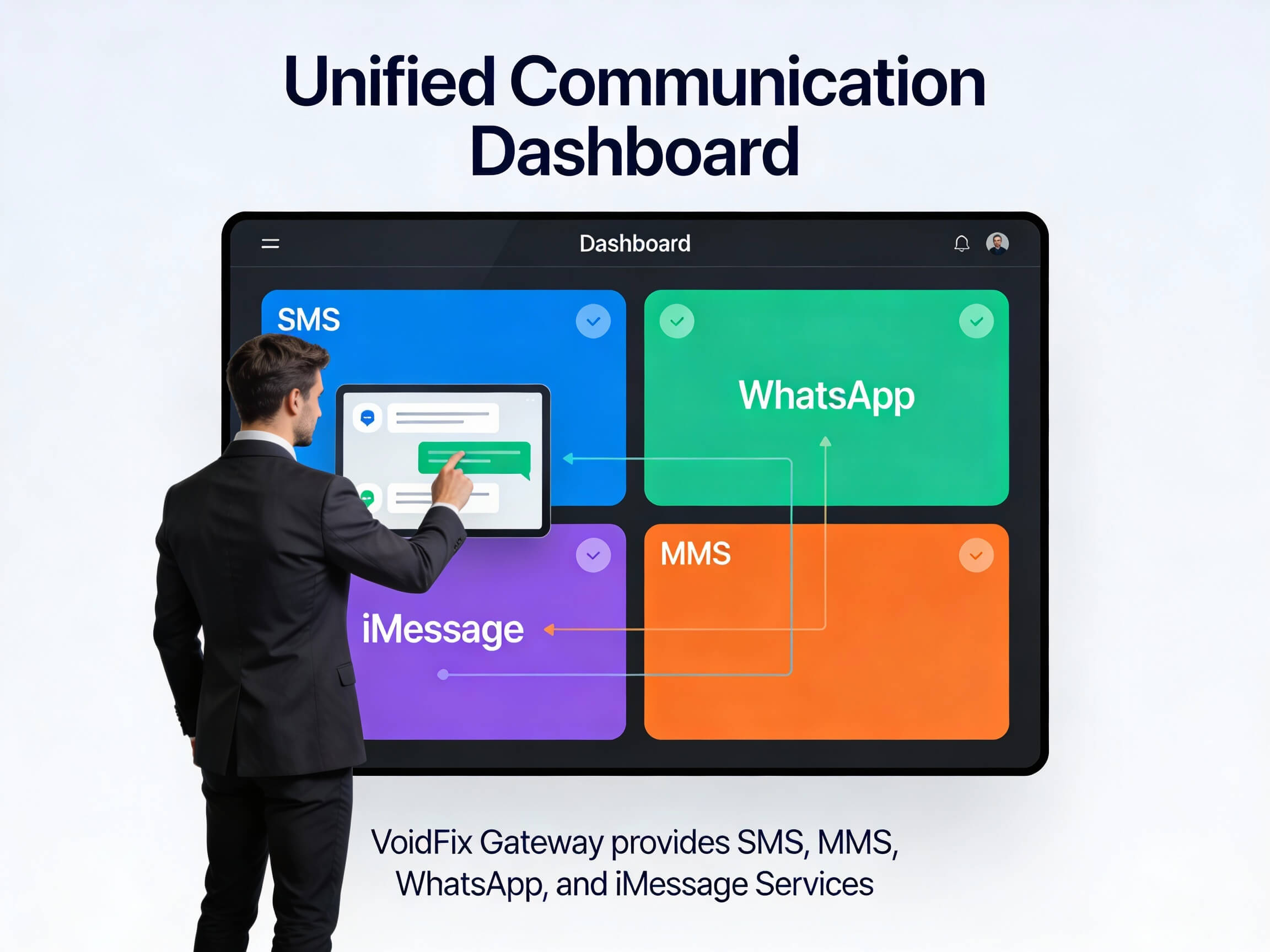
Multi-channel included: SMS, MMS, WhatsApp, and iMessage support under one plan
The result is that most businesses save 40-70% compared to Twilio, with savings increasing proportionally as message volume grows.
Delivery Rates and Performance: Getting Messages to Inboxes
In this Twilio SMS comparison, delivery performance is where architectural differences create the most noticeable impact on daily operations.
Twilio Delivery Challenges
Twilio routes messages through aggregator networks and carrier gateways. While this approach provides broad reach, it introduces several delivery vulnerabilities:
Carrier-level filtering can silently block messages without notification
Aggregator routing adds latency, especially during peak sending periods
A2P compliance issues can cause entire campaigns to be suspended
OTP delivery failures during high-traffic periods frustrate end users
Different carriers apply different filtering rules, creating inconsistent delivery rates
VoidFix Gateway Delivery Advantages
VoidFix Gateway's SIM-based delivery approach sidesteps many of these issues:
Messages are sent as native SMS through real SIM cards, reducing filtering risk
Real-time socket-based delivery provides instant status updates
No aggregator middlemen means fewer points of failure in the delivery chain
Consistent delivery rates across carriers because messages originate from actual phone numbers
For businesses where every message matters, whether it is an OTP, an appointment reminder, or a time-sensitive promotion, VoidFix Gateway's delivery architecture provides measurably better reliability.
Head-to-Head Feature Comparison Table
The following table provides a side-by-side VoidFix vs Twilio comparison across the features that matter most for high-volume messaging operations:
Feature
Twilio
VoidFix Gateway
Pricing Model
Per-message + surcharges
Flat rate per SIM line
A2P Registration
Required (weeks to approve)
Not required
Setup Time
Days to weeks
Hours
SMS Delivery Method
Aggregator/carrier routes
Direct SIM-based
WhatsApp Support
Yes (conversation-based pricing)
Yes (included in platform)
MMS Support
Yes (additional cost)
Yes (included)
Message Scheduling
Requires custom code
Built-in
Spintax Support
Not available
Built-in
AI Chatbot
Requires third-party integration
Built-in
Two-Way Messaging
Yes
Yes
CRM Integration
Via API (developer required)
GoHighLevel, Zoho, Zapier, Make
Technical Expertise Needed
High (developer-first)
Low to moderate
Support
Tiered (paid priority support)
Dedicated support included
Setup Time and Onboarding Experience
One of the most overlooked factors in any SMS provider comparison is how quickly you can go from signing up to actually sending messages.
Twilio Setup Process
Getting started with Twilio involves multiple steps that can stretch the timeline considerably:
Create a Twilio account and verify your identity
Purchase phone numbers for sending
Complete A2P brand registration with The Campaign Registry
Submit campaign use cases for carrier approval
Configure webhooks, APIs, and error handling in your application
Test delivery across different carriers before going live
The A2P registration step alone can take one to four weeks, and rejections may require resubmission with revised campaign descriptions.
VoidFix Gateway Setup Process
Sign up for VoidFix Gateway and select your plan
Connect your Android device with an active SIM card
Configure your dashboard, import contacts, and set up templates
Integrate with your CRM or automation tools using pre-built connectors or the API
Begin sending messages immediately with real-time tracking
Most businesses are fully operational within a few hours. There is no A2P registration wait, no carrier approval bottleneck, and no complex developer setup required.
Integration Ecosystem and Automation Capabilities
Both platforms offer integration capabilities, but the approach and accessibility differ significantly in this Twilio SMS comparison.
Twilio provides powerful APIs that developers can use to build virtually any messaging workflow. However, every integration requires custom code, testing, and maintenance. For businesses without dedicated engineering resources, this creates a dependency on external developers or agencies.
VoidFix Gateway offers a balance of API flexibility and pre-built integrations:
GoHighLevel: Direct integration for agency workflows, pipelines, and automated follow-ups
Zapier and Make: No-code automation that connects VoidFix to thousands of applications
REST API and Webhooks: Full programmatic access for custom SaaS and enterprise integrations
Bubble.io: Native support for no-code application builders
Zoho CRM: Automated messaging within your existing customer relationship management workflows
This hybrid approach means technical teams can build sophisticated custom integrations while non-technical users can set up automation through visual interfaces.
Customer Support and Service Quality
When messaging infrastructure encounters issues, the quality and responsiveness of customer support becomes critical.
Twilio operates a tiered support model where basic support is included but priority response times require paid plans that can cost hundreds to thousands of dollars monthly. Many businesses on standard plans report long wait times for non-critical issues and limited access to direct human support.
VoidFix Gateway includes dedicated support as part of its service offering. Users consistently report faster response times, more personalized assistance, and proactive guidance during setup and scaling. For agencies and SaaS platforms where messaging downtime directly impacts revenue, this level of support accessibility is a significant differentiator.
Best Use Cases for Each Platform
When Twilio Makes Sense
Large enterprises with dedicated development teams that need granular API control
Businesses requiring voice, video, and email alongside SMS through a single vendor
Organizations with low to moderate messaging volume where per-message costs remain manageable
Companies operating in highly regulated industries where A2P compliance is already part of their workflow
When VoidFix Gateway Is the Better Choice
Agencies managing multi-client SMS and WhatsApp campaigns at scale
SaaS platforms sending high volumes of transactional messages, OTPs, and alerts
Companies that need to start sending immediately without A2P registration delays
Organizations that value built-in features like scheduling, spintax, and AI chatbots over raw API flexibility
Teams without dedicated developers who need pre-built CRM and automation integrations
Conclusion: Which SMS Provider Should You Choose?
This SMS provider comparison makes one thing clear: while Twilio remains a capable platform with broad channel coverage, its pricing model and operational complexity are increasingly misaligned with the needs of modern, high-volume messaging operations.
VoidFix Gateway delivers a more compelling value proposition for businesses where SMS and WhatsApp are core communication channels. The combination of flat-rate pricing, SIM-based delivery, instant setup, built-in advanced features, and accessible integrations creates a platform that is purpose-built for the way businesses actually use messaging in 2026.
If you are evaluating VoidFix vs Twilio for your business, the decision often comes down to this: do you need a developer-centric platform with broad channel coverage, or do you need a messaging platform that delivers better economics, faster deployment, and higher reliability for SMS and WhatsApp at scale? For the growing majority of agencies, SaaS companies, and customer-facing businesses, VoidFix Gateway is the clear winner. Explore plans and features at gateway.voidfix.com.
Frequently Asked Questions
How does VoidFix Gateway achieve better delivery rates than Twilio?
VoidFix Gateway sends messages through real SIM cards connected via Android devices, which means messages appear as native SMS to carriers. This approach avoids the aggregator routing and A2P filtering that can block or delay messages sent through traditional cloud-based providers like Twilio. The result is more consistent delivery across all carriers.
Can VoidFix Gateway handle the same message volume as Twilio?
Yes. VoidFix Gateway is engineered for high-volume messaging operations. Businesses can scale by adding additional SIM lines to increase throughput, and the platform handles thousands to millions of messages with built-in smart routing, message queuing, and real-time delivery tracking. Many agencies and SaaS platforms use VoidFix to send hundreds of thousands of messages monthly.
What happens if I need both SMS and WhatsApp messaging?
VoidFix Gateway supports both SMS and WhatsApp (along with MMS and iMessage) under a single platform. Unlike Twilio, which charges separately for each channel with different pricing models, VoidFix provides unified multi-channel messaging with straightforward pricing and a single dashboard for managing all communication channels.
Is migrating from Twilio to VoidFix Gateway difficult?
The migration process is straightforward. VoidFix Gateway offers comprehensive API documentation, pre-built integrations with popular platforms, and dedicated support to assist with the transition. Most businesses complete their migration and are fully operational on VoidFix within hours, not weeks. Contact lists, templates, and automation workflows can be transferred with minimal disruption to ongoing messaging operations.