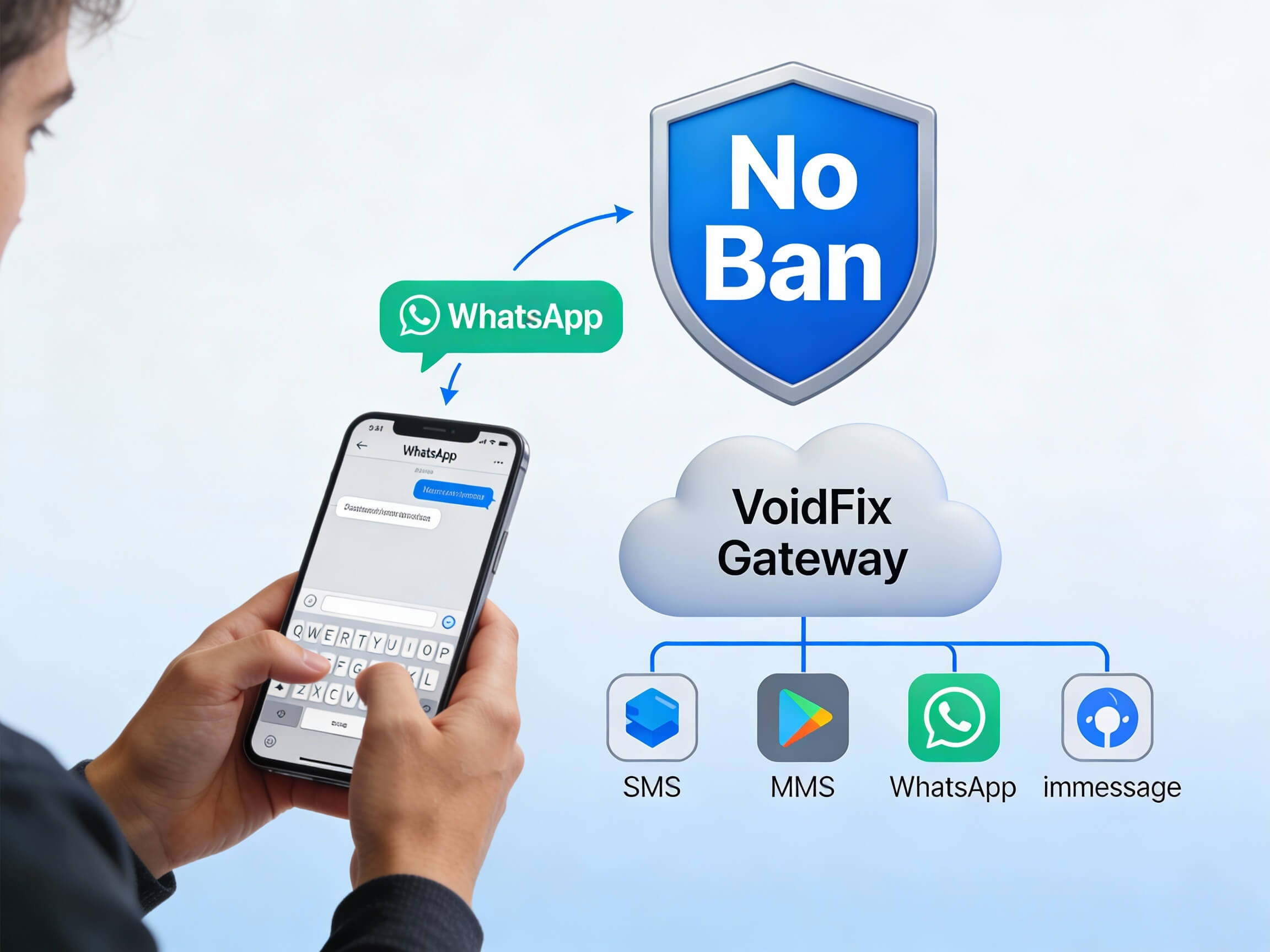
The WhatsApp Business API is how growing companies move beyond the basic app to automate, integrate, and scale conversations with over two billion users worldwide. It powers everything from order alerts to chatbots and full marketing journeys.
This complete 2026 guide explains how the API works, what templates and pricing mean for you, and how to launch without the usual complexity. We also show how VoidFix Gateway makes WhatsApp messaging simple, affordable, and easy to integrate.
What the WhatsApp Business API Really Is
The WhatsApp Business API is Meta's enterprise messaging platform, designed to let businesses send and receive WhatsApp messages programmatically rather than tapping them out by hand. Crucially, the API has no app or chat screen of its own. It is a connection layer that plugs into your CRM, helpdesk, marketing platform, or custom software, turning WhatsApp into a channel you can automate and scale across your whole operation.
This is what separates it from the consumer WhatsApp app and the free WhatsApp Business app. Those tools are designed for individuals and small teams handling conversations manually on a single phone. The API is built for companies that need to message thousands of customers, route conversations to many agents, run chatbots, and trigger messages automatically from other systems. If your messaging has outgrown a single phone, the API is the next step.
It is worth understanding why WhatsApp has become so important for business communication in the first place. With over two billion users across more than a hundred and eighty countries, it is the default messaging app for huge parts of the world, particularly across Latin America, Europe, the Middle East, Africa, and South Asia. Open rates on WhatsApp routinely outperform email by a wide margin, and customers tend to treat it as a personal, high-trust space. That combination of reach and engagement is exactly what makes the API such a valuable channel for companies that learn to use it well.
How the API Works: Sessions, Templates, and Opt-Ins
To use WhatsApp responsibly at scale, Meta enforces a few core concepts that every business needs to understand. Getting these right is the foundation of a compliant, high-performing program.
Opt-in first: You can only message people who have agreed to hear from you on WhatsApp. Consent protects your account and your reputation.
The 24-hour service window: When a customer messages you, a 24-hour window opens during which you can reply freely with regular messages.
Template messages: To start a conversation or message outside the 24-hour window, you must use a pre-approved template. Templates are reviewed by Meta before use.
Message categories: Templates fall into categories such as marketing, utility, and authentication, which affect how they are priced and treated.
Quality rating: Meta scores your number based on how recipients react. High block and report rates lower your rating and limit your reach.
Understanding this framework is essential, because it governs what you can send, when, and at what cost. These rules can feel restrictive at first, but they exist to keep WhatsApp a trusted, low-spam environment, which is precisely what makes the channel so effective. Businesses that respect the framework enjoy strong engagement and stable accounts, while those that try to work around it tend to see their quality rating fall and their reach shrink. The smart move is to treat the rules as guardrails that protect a valuable channel rather than obstacles to be dodged.
What You Can Do With It
The real value of the WhatsApp Business API is the breadth of use cases it unlocks once it is connected to your systems. A single integration can power many parts of the customer journey.
Notifications and alerts: Send order confirmations, shipping updates, appointment reminders, and account alerts with high open rates.
Customer support: Run two-way conversations with read receipts and rich media, routed to the right agents or handled by bots.
Marketing campaigns: Deliver opt-in broadcasts, product launches, and promotions that feel personal inside chat.
Automation and chatbots: Qualify leads, answer FAQs, and guide customers around the clock without staffing every hour.
Commerce: Share catalogs, take orders, and nudge customers through checkout directly in the conversation.
Because these flows run through automation, they scale without scaling your headcount, which is exactly why high-volume businesses adopt the API. A small team can support a very large customer base when routine questions are answered automatically and only genuinely complex cases reach a human. The same applies to outbound communication: a single well-built template can send personalized updates to your entire customer base in minutes, work that would be impossible to do by hand. This leverage is the practical payoff of moving from the app to the API.
Understanding WhatsApp Pricing in 2026
Pricing is one of the most confusing parts of the WhatsApp Business API, and it has evolved considerably. Meta has moved toward conversation- and message-based pricing that varies by message category and by country, and the model continues to shift year over year. On top of Meta's own charges, most providers layer their own platform or per-message fees, which can make costs unpredictable and surprisingly steep at volume.
For a business sending tens or hundreds of thousands of messages, those stacked fees add up fast and make budgeting difficult. This is where the choice of provider matters enormously. A platform that controls per-message platform fees can dramatically reduce your total cost. VoidFix Gateway, for example, uses a flat, predictable subscription with no per-message platform fees, which helps businesses save up to roughly 80% on their messaging costs compared with traditional per-message models.
The hidden cost of per-message pricing is not just the headline rate but the way it discourages experimentation. When every message has a price tag, teams hesitate to test new campaigns, expand their audience, or add helpful utility notifications, because each one nudges the bill higher. A flat model removes that friction entirely. You can scale your messaging in line with what your business needs rather than what your invoice can tolerate, and you can forecast spend with confidence instead of bracing for a surprise at the end of the month. For high-volume senders, that predictability is often as valuable as the raw savings.
Common Challenges When Launching
Many teams underestimate how much work goes into a traditional WhatsApp API rollout. Knowing the friction points ahead of time helps you choose an approach that avoids them.
Account and number setup: Verifying your business and provisioning numbers can be slow and technical.
Template approvals: Every outbound template needs Meta's approval, and rejections cause delays if you do not know the rules.
Integration complexity: Wiring the API into your CRM and workflows often requires developer time.
Maintaining quality rating: Poor targeting and irrelevant messages can degrade your number's standing and throttle your reach.
Unpredictable costs: Per-message and conversation fees make it hard to forecast spend as you grow.
None of these are insurmountable, but together they explain why many businesses prefer a managed platform that handles the heavy lifting.
How VoidFix Gateway Simplifies WhatsApp
VoidFix Gateway is a bulk messaging platform that covers WhatsApp alongside SMS and iMessage, and it is built to remove the friction described above. Rather than wrestling with setup, template approvals, and developer integrations on your own, you get a platform that streamlines the path to live WhatsApp messaging so you can focus on your campaigns instead of plumbing.
Integration is a core strength. VoidFix Gateway connects to GoHighLevel, CRMs, Zapier, Make, webhooks, and a REST API, so WhatsApp fits directly into the automations and pipelines you already run. Marketing agencies, e-commerce stores, healthcare providers, real estate teams, and SaaS platforms use these connections to trigger WhatsApp messages from their existing systems. And with a flat subscription and no per-message platform fees, your costs stay predictable as you scale. If you want to plan an integration, contact our team for guidance.
Because VoidFix Gateway covers WhatsApp, SMS, and iMessage in one place, you also get a unified approach to messaging rather than a patchwork of separate vendors. That means you can reach a customer on WhatsApp where they prefer it, fall back to SMS where they do not use WhatsApp, and add the premium feel of iMessage for Apple users, all from a single platform and a single integration. Consolidating channels this way simplifies your tooling, reduces the number of contracts you manage, and gives you a clearer view of how customers respond across every channel you use.
Best Practices for a High-Performing Program
Whichever way you launch, a few habits separate WhatsApp programs that thrive from those that get throttled. Build these into your strategy from day one:
Always collect clear opt-ins and make it easy to opt out.
Keep templates relevant and segment your audience so messages matter to each recipient.
Respond inside the 24-hour window to maximize free-form conversations and engagement.
Lead with utility messages like updates and reminders, which customers welcome, before heavy promotion.
Monitor your quality rating and adjust quickly if reports or blocks rise.
The WhatsApp Business API remains one of the most powerful channels available in 2026, connecting your business to billions of users with automation, rich media, and high engagement. The catch has always been the complexity and cost of getting there. By understanding templates, the service window, pricing, and quality ratings, you can run a program that performs and stays compliant. And by choosing a platform like VoidFix Gateway that simplifies setup, integrates with your stack, and keeps costs flat with no per-message platform fees, you skip the hardest parts entirely. Start your free trial today and put WhatsApp to work for your business, no credit card required.