Turn Texts Into Revenue On Autopilot
SMS automation lets your business send the right text to the right person at exactly the right moment, without anyone hitting send. From appointment reminders to abandoned-cart nudges, automated workflows work around the clock so no opportunity slips through.
The challenge is doing it affordably and reliably at scale, without per-message fees eating your margins. This guide covers the workflows worth building first and how VoidFix Gateway sends them from your own SIMs.
What SMS Automation Actually Means for a Business
SMS automation for business is the practice of sending text messages automatically based on rules, triggers, schedules or customer actions rather than typing each one by hand. You design a workflow once, define what should fire it, and the system handles the rest, day and night, with no human in the loop. Almost every customer has a phone that receives texts, and most people read them quickly, so automating texts is one of the highest-impact moves a growth team can make.
The shift matters because manual messaging does not scale. A receptionist can text a handful of reminders an hour, but a workflow can send thousands the moment they are due. Automation also removes the inconsistency of human follow-up. Every lead gets the same timely sequence, every customer gets the same confirmation, and nothing falls through the cracks during a busy week or a holiday.
The Anatomy of an Automated SMS Workflow
Every automated text workflow is built from three parts: a trigger, a condition, and an action. Understanding these makes it easy to design sequences that feel personal instead of robotic.
- Trigger: the event that starts the workflow, such as a new lead, a booked appointment, an abandoned cart, a completed purchase or a date on the calendar.
- Condition: the logic that decides who qualifies and what happens next, like whether a customer replied, whether an invoice is still unpaid, or which segment they belong to.
- Action: the message itself, including timing, personalization tokens and any branching follow-ups based on the recipient's response.
Good automation also respects opt-out. Every sequence should honor STOP keywords instantly and suppress contacts who have unsubscribed, keeping you compliant and protecting your sender reputation.
High-Revenue SMS Workflows Worth Building First
Not all automations carry equal weight. If you are starting from scratch, these workflows consistently produce the fastest return because they intercept moments where money is already on the line.
- Appointment and booking reminders: A 24-hour and 1-hour reminder pair helps cut no-shows for clinics, salons, agencies and service businesses. Each prevented no-show is recovered revenue.
- Abandoned-cart recovery: A nudge 30 to 60 minutes after a cart is left, followed by a gentle reminder the next day, recaptures sales that would otherwise vanish.
- Lead speed-to-response: Leads go cold fast, so texting a new lead within the first minute gives you the best chance of a reply. Automation guarantees that first touch happens instantly, even at 2 a.m.
- Post-purchase and review requests: Order confirmations, shipping updates and a well-timed review ask build trust and generate the social proof that drives future sales.
- Win-back and re-engagement: A scheduled message to customers who have gone quiet for 60 or 90 days revives dormant revenue at almost no cost.
Layered together, these workflows form a revenue engine that runs continuously without adding headcount. For deeper tactics on building campaigns at scale, see our complete guide to bulk SMS marketing.
Triggered Messages vs Scheduled Campaigns
Two broad styles of automation exist, and the best programs use both. Triggered messages react to behavior in real time, an order placed, a form submitted, a stage changed in your pipeline. They feel personal because they arrive in direct response to something the customer just did.
Scheduled campaigns, by contrast, go out at a planned time to a defined audience: a flash-sale broadcast, a seasonal reminder, a monthly statement notice. They are predictable and easy to plan around inventory or promotions. The art is blending the two so that your evergreen triggers handle the day-to-day while scheduled sends drive your bigger pushes.
When to choose each
Use triggered flows for anything tied to an individual's actions and timing. Use scheduled campaigns when the timing is the same for everyone and the message is broadcast in nature. Most businesses find that triggered flows quietly deliver the majority of automated revenue while scheduled campaigns create the visible spikes.
Why Deliverability Makes or Breaks Automation
An automated workflow is only as valuable as the messages that actually arrive. As automated traffic ramps up, carriers look at it more closely. On aggregator routes, unregistered or low-trust campaigns get throttled or filtered before they reach a phone. You rarely see the failure, but you feel it in flat results.
VoidFix Gateway sends through Android phones with real SIMs, so each text comes from a normal mobile number. That route still has limits. CTIA's Messaging Principles count every text a business sends as Non-Consumer traffic, and carriers can filter or suspend a SIM line that sends far more than a person would or draws complaints. Spread volume across several SIMs with the Number Pool, ramp new numbers with Number Warmup, and vary wording with Spintax. Small delivery gaps add up fast in automation, so check delivery reports, not just sent counts.
Launch Without A2P 10DLC Registration or Per-Message Fees
Two friction points stall most SMS automation projects: registration and cost. On legacy platforms, automated campaign traffic typically requires A2P 10DLC registration, brand vetting, campaign approval and ongoing fees, a process that can delay launch by days or weeks. On top of that, per-message pricing means your costs rise in lockstep with your success, punishing the very growth you worked for.
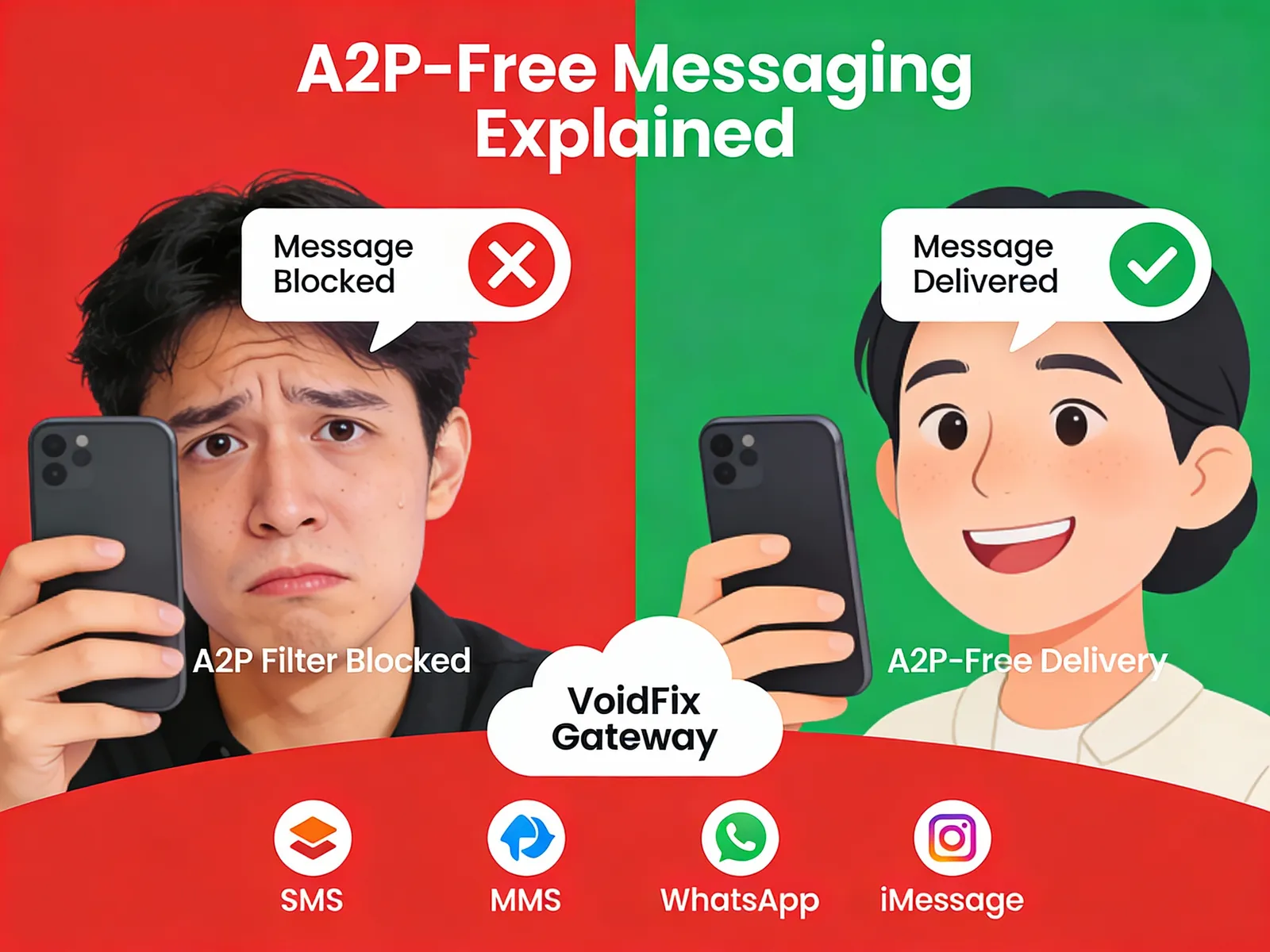
VoidFix Gateway handles both differently. Messages go out from your own SIMs, a person-to-person route, so A2P 10DLC registration is not part of the setup and you can launch workflows the day you connect a phone. Consent, opt-outs and quiet hours still apply, and your SIM plan's fair-use terms still count. Read more on sending SMS without A2P registration. Instead of per-message platform fees, you pay a flat monthly subscription, which can cut messaging costs by up to 80%. For automation that may fire tens of thousands of texts a month, that pricing model is the difference between a profitable channel and a cost center. If you want help mapping your current spend, you can contact our team.
Connecting Automation to Your Existing Stack
The fastest path to value is plugging SMS into tools you already use rather than rebuilding your processes. VoidFix Gateway integrates with GoHighLevel, popular CRMs, Zapier, Make, webhooks and a REST API. That means a pipeline stage change in your CRM, a new row in a spreadsheet, a paid invoice or a booked calendar slot can all become the trigger that fires a text.
This event-driven setup is what makes automation feel easy. Your sales, marketing and operations tools become the brain, and VoidFix Gateway becomes the delivery layer that turns every important event into a timely, trusted message. Developers can wire custom logic through the REST API, while non-technical teams can build the same flows visually in Zapier or Make.
If you build workflows in GoHighLevel, our GoHighLevel setup documentation shows how to send them through your own SIMs.
Conclusion: Build Once, Earn Continuously
SMS automation for business rewards the work you do once with revenue you collect indefinitely. Reminders that prevent no-shows, cart nudges that recover sales, instant lead responses that win deals, and win-back sequences that revive dormant customers all run quietly in the background while your team focuses on bigger work. The key is pairing smart workflows with delivery that actually lands and pricing that does not punish your growth. VoidFix Gateway gives you real-device delivery from your own SIMs, no A2P registration step and flat monthly pricing, so your automation stays profitable as it grows. Start your free 7-day trial with no credit card required and turn your first revenue-driving workflow on today.